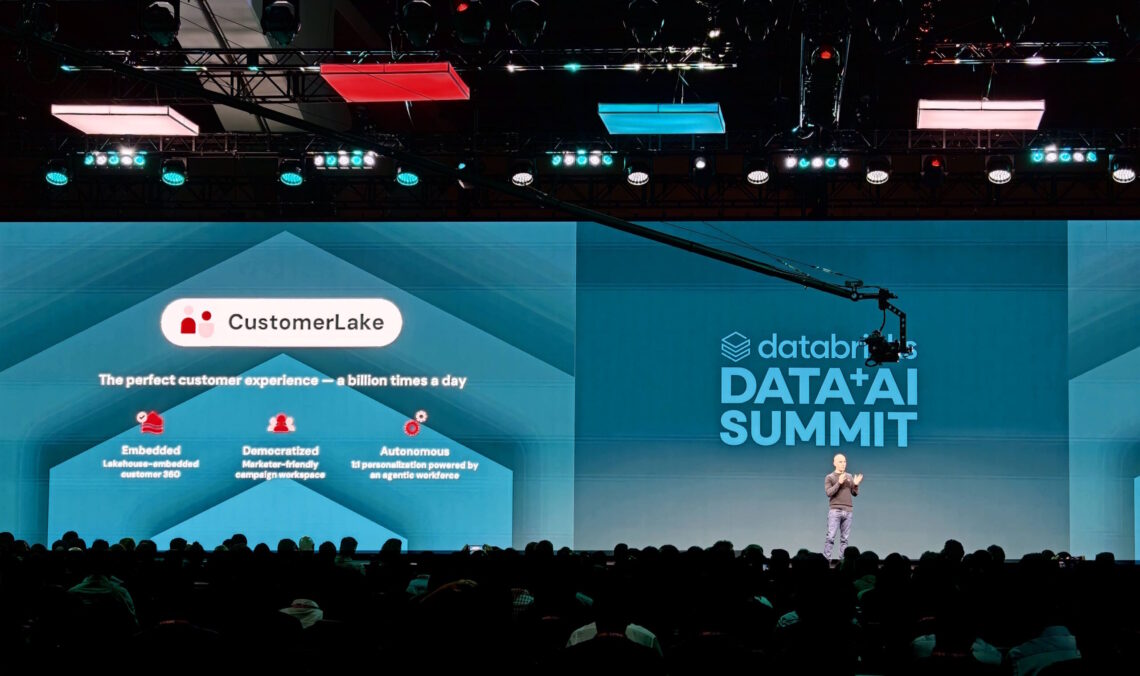
The boundaries of the martech stack just got incredibly blurry. At its Data + AI Summit in San Francisco, data infrastructure titan Databricks made a aggressive play directly into the marketing application layer with the announcement of CustomerLake, an “Agentic CDP.”
Currently sitting in Private Preview, CustomerLake represents a massive shift in how enterprise customer data is managed and activated. Instead of forcing brands to pack up and ship their data to a separate, third-party CDP database, Databricks is building the activation layer directly on top of the lakehouse.
The Core Capabilities
Managed entirely under Databricks’ Unity Catalog governance framework, CustomerLake relies heavily on AI automation to replace manual marketing labor:
- Profile Agents: Autonomous models that handle the heavy lifting of data cleansing, identity resolution, and synthesizing a trusted Customer 360 profile.
- Campaign Agents: AI assistants that move away from rigid, rule-based audience builders, allowing marketers to launch what Databricks calls “Infinity Campaigns”; essentially continuous, real-time optimization loops focused on specific business goals.
Because the data and the foundational AI models already live in the lakehouse, Databricks argues that keeping the CDP there is the only architecture that makes sense for the real-time AI era.
What the Experts are Saying
An announcement this disruptive naturally triggered a wave of analysis across the industry, with thought leaders split between technical optimism and historical skepticism.
The Stack is Inverting
Martech analyst Scott Brinker pointed out a fascinating structural reversal happening in the industry. For nearly a decade, the narrative focused on marketing application platforms trying to build downward to create their own data layers. Now, the tables have turned. Databricks represents a pure-play infrastructure giant moving upward to claim the application tier. While the underlying data pipeline is solid, Brinker notes that the real differentiators here are the autonomous agents running natively inside the system.
Infrastructure Solidifies the CDP
For David Chan, a veteran in customer data strategy, this move is a major validation for a category many claimed was dying. Critics have long predicted the commoditization of the standalone CDP, but Chan argues that Databricks’ entry proves the exact opposite. If real-time personalization and autonomous AI agents require clean, permissioned data to function, the CDP isn’t getting phased out; it is becoming an indispensable, foundational infrastructure capability.
The Composable Backfire
Independent analyst and Martech Therapy founder Matthew Niederberger highlighted a deep, structural irony pointing straight at the current vendor ecosystem. For years, composable CDP players marched around telling enterprise brands to pull their data out of isolated tools and centralize it inside the lakehouse. By successfully winning that argument, those vendors accidentally built the perfect native on-ramp for Databricks to cut them out entirely.
Furthermore, Niederberger flags an existential economic threat for standalone tools. Because Databricks makes its real margins on underlying cloud storage and compute power, it can price its application layer aggressively. As he cleanly puts it:
“You cannot win a price war against a company that does not need your product to make money.”
The Return of the Enterprise Bundle
Offering a dose of historical reality, Snowflake’s Florian Delval noted that software permanently operates in a loop of bundling and unbundling, and we have seen this exact play before. Decades ago, database giants like Teradata, IBM, and Oracle bought up marketing tools to sit directly on top of their systems, only to eventually lose focus and divest them when marketing was no longer deemed core to their business.
In a classic industry irony, Delval points out that Tasso Argyros – the engineering leader spearheading CustomerLake – previously co-founded a packaged CDP (ActionIQ) and Aster Data (which sold to Teradata). Argyros effectively helped unbundle the warehouse-marketing model years ago, and now he is the one bundling it back together. While Delval credits Databricks for designing a smart hybrid UI, combining traditional visual builders with AI chat rather than forcing marketers into a blank text box, he warns that enterprise buyers will face messy operational overlaps and duplicate data logic by running CustomerLake alongside legacy tools.
The Verdict: A High-Stakes Shift
Is CustomerLake a slam dunk? Architecturally, it respects data gravity and eliminates the painful pipeline maintenance that tortures enterprise IT departments.
But technology is rarely the element that breaks a marketing stack; organizational adoption is. Databricks is used to selling to data scientists and IT architects. Winning over execution-focused marketing teams who live in day-to-day campaign workflows is a completely different beast.
Databricks has officially lit a fire on the customer data battlefield. Whether CustomerLake becomes the new enterprise standard or just another chapter in tech’s endless loop of bundling and unbundling is a question only time will answer.