

The conversation around artificial intelligence in marketing has shifted. The initial wave of generative AI focused heavily on prompt-based assistance, where people explicitly asked a chatbot to write an email, draft a blog post, or generate an image.
The current landscape is moving toward Agentic AI. Rather than acting as passive assistants that require constant prompting, AI agents are software programs designed with a degree of autonomy. They use reasoning models, access local data, and execute multi-step workflows across different software platforms via APIs (Application Programming Interfaces).
However, separating enterprise utility from marketing hype requires a look at current adoption data and structural realities.
The Intent vs. Reality Gap
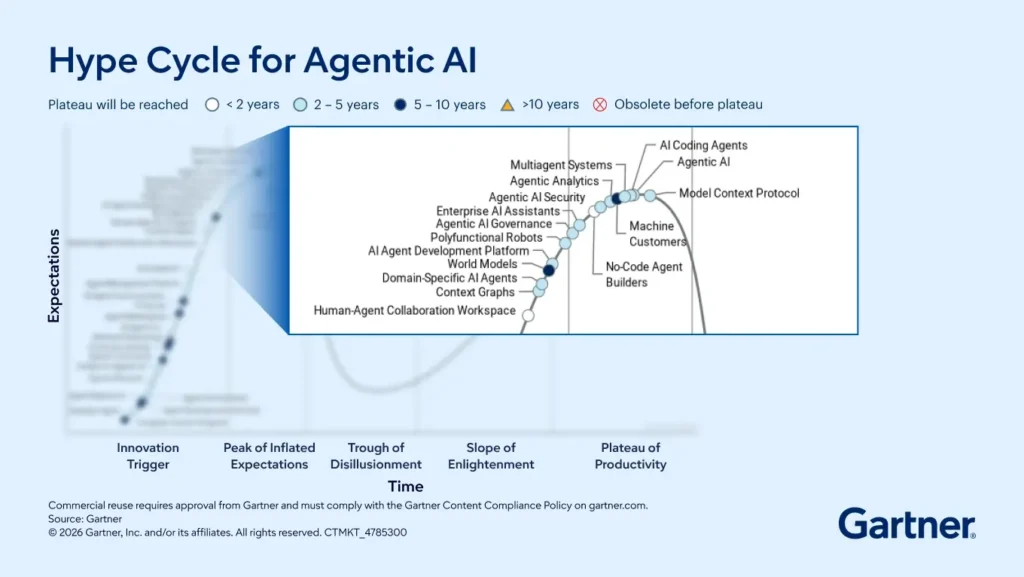
According to data from the Gartner Hype Cycle for Agentic AI, these systems are currently sitting at the Peak of Inflated Expectations. There is a significant gap between what marketing teams want to achieve and what is actually running live in production:
-
Over 60 percent of organizations report plans to deploy AI agents within the next two years.
-
Only about 17 percent of those organizations have fully functioning agents live in production environments right now.
Structural Realities and Project Risks
Building an autonomous marketing assistant sounds ideal until it hits legacy corporate infrastructure. Projections indicate that roughly 40 percent of early agentic AI projects will be canceled or paused. The main roadblocks are structural rather than technical:
-
Unclear ROI: Proving exactly how an autonomous, cross-platform workflow impacts the bottom line remains difficult.
-
Escalating Compute Costs: Running reasoning models over massive enterprise datasets continuously gets expensive quickly.
-
Inadequate Data Governance: If internal customer data is messy or poorly protected, giving an autonomous agent free rein over company systems presents too much risk.
The Baseline Trap
Right now, widespread AI adoption is stuck in a baseline trap. While over 90 percent of marketers regularly use generative AI for basic text summaries and brainstorming, truly autonomous cross-platform execution remains rare. The promise of Agentic AI is real, but scaling it successfully will ultimately depend on brands fixing their data foundations first.

